Key figures
Chapter 7: Domestic Reform and War, 1910 - 1914
The New Anti-Giolittianism
For the second time in four years the official opposition held power only by the toleration of the Giolittian majority. As a result, charges of a Giolittian parliamentary “dictatorship” inevitably gained currency. Giolitti’s opponents increasingly contrasted a parasitic political Italy—Montecitorio and its master, Giolitti—to a “real,” productive, Italy. If the Chamber of Deputies was so dominated by one man that it could no longer be the basis for opposition, then opposition would have to move outside of and against parliament. Discontent with giolittismo came from many sources. Part of the democratic left, especially with ties to the South, resisted. Gaetano Salvemini had long contended that only a radical break with the Giolittian system and the introduction of sweeping and substantial reform would lay the foundation for a democratic Italy. His bitter anti-Giolittianism found a ready audience among the discontented young intellectuals who wrote for the Florentine review La Voce after 1908.
La Voce provided a forum for various strands of left and right anti-Giolittian sentiment. Hostility was directed at all parts of the Giolittian consensus.¹ Voce editor Giuseppe Prezzolini wrote: “The present democracy . . . represents by now only the decline of all standards . . . only the interests of the most greedy and aggressive are served.” After almost ten years of Giolittian government, “Everything falls. Every ideal evaporates. Parties no longer exist, only little factions and clienteles. . . . The disgust is overwhelming. The best no longer have any faith. The young, if they are not spineless climbers, no longer enter parties.” Prezzolini’s question, “What to do?” revealed a general frustration. He noted that Giolitti’s policies “ended by producing a reaction, first among a few, then in larger numbers; a reaction on the conservative side called nationalism, and on the opposing side called revolutionary socialism.”³ In fact, the Italian Nationalist Association, founded in 1910, saw imperialism and war as a way of overthrowing Giolitti by forging new antidemocratic values.⁴
But not just young intellectuals swelled the ranks of those alienated from the Giolittian consensus. Conservatives had been angered by the battle over the maritime conventions and Sidney Sonnino’s failure. On the left, longtime Neapolitan socialist deputy Ettore Ciccotti called Giolittianism “the death of political life.” The Radical ex-priest Romolo Murri fulminated that Giolitti “governed through circulars to prefects, but rarely, almost never, has he felt the need to come here to speak a word that might stir the soul of the country, that indicated to us an ideal to conquer.”⁵
Sonnino to Luzzatti
A tired and embattled Giolitti had wanted Sonnino to stay in power until he could reorganize his own political fortunes. The only danger faced by the Giolittians was a premature dissolution of the Chamber of Deputies, but Sonnino knew from Pietro Bertolini and Giuseppe Marcora that the Giolittians would not tolerate such a move.⁶ Yet even Giolitti’s goodwill could not save the inept Sonnino from himself. The Tuscan lacked the political skills to control the Chamber, and his government failed to win the same toleration from the Estrema that it won from the Giolittians. On the confidence vote the Radicals, Socialists, Republicans, and Sinistra Democratica (ex-Zanardellians) all voted against the government. Sixty-five of the 193 pro-government votes were from Giolittians.⁷
In the end, Sonnino, like Giolitti before him, failed to come up with a satisfactory solution to the maritime conventions. Although the government cut the term of the contracts to fifteen years, renegotiated the subsidies downward, and grouped all maritime services under the Navy Ministry, the Socialists criticized the project as a victory for the Navigazione Generale. Concessions made to the Southern ports lost support in the North. Giolitti, in a show of support for Sonnino, left Rome in early March after saying that he did not want a crisis, but the Giolittian majority revealed just how far it was from being a true political party.
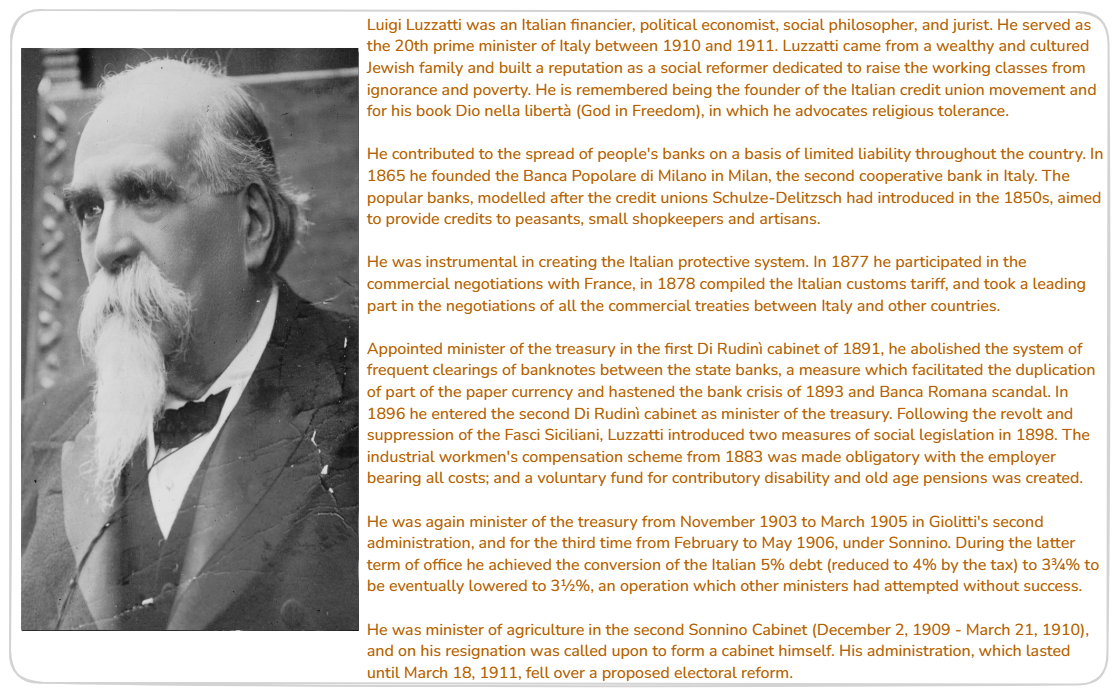
With Sonnino out of the picture and Giolitti disinclined to return, the Giolittians faced a problem. Vittorio Emanuele Orlando cropped up as a possible candidate, but Giolitti did not want to encourage a younger competitor, especially one who might put together a combination with the Radicals and cut the curious alchemy of the Italian Parliament for an opening to the left. Then the within Sonnino’s government when the conservative social reformer Luigi Luzzatti put together the sane right-left coalition aspired to by orlando, but without becoming a rival to Giolitti himself. The choice of Luzzatti, a former ally of Antonio di Rudinì and veteran minister from the times of the Historic Right, disconcerted many conservatives, who did not expect it.⁹ Luzzatti was quite frank with Giolitti about the difficulties of forming a viable government with “the majority that only you hold together,” but Giolitti worked actively to see that Luzzatti succeeded by persuading Antonino di San Giuliano to take the foreign ministry. More important, he used the formation of the Luzzatti ministry to accelerate his own negotiations for a future government with the Radicals.¹⁰
The only complication was a brief struggle for control of the Roman paper La Tribuna. The same powerful interests that had fought Giolitti so bitterly over the maritime conventions now extended a peace offering in the form of Luigi Roux’s paper, plagued by financial and morale problems and losing ground to Sonnino’s Giornale d’Italia and the democratic Il Messaggero. With Italy’s most prestigious newspaper, Il Corriere della sera, unrelentingly anti-Giolittian, only La Stampa of Turin, whose director, Alfredo Frassati, had gradually become an admirer of Giolitti, who had taken a beating in the press over the maritime conventions, ==control of La Tribuna was a high priority,==but Luzzatti, probably urged on by Luigi Albertini, promoted the candidacy of Andrea Torre, an anti-Giolittian deputy and political correspondent for the Corriere della sera.¹¹
The Banca Commerciale’s director, Otto Joel, who actually controlled the majority of the Tribuna’s stock, clearly understood that another Giolitti government was not far off. Commerciale president, Cesare Mangili, explained that Joel now believed “that it is a duty of an important credit institution to support certain political desires of eminent persons in the country.” Prefect of Genoa Camillo Garroni, the Giolittian deputy and industrialist Enrico Maraini, and Vittorio Rolandi-Ricci, a lawyer for the Navigazione Generale, formed a consortium to purchase control of the Tribuna and to install Olindo Malagodi, the Tribuna’s London correspondent, as director.¹² Garroni, Joel, and Rolandi-Ricci left no doubt that the new director should be under no illusions that he was working for the Commerciale: “Malagodi . . . must know that if he is nominated, he owes it solely to the choice of Your Excellency and will remain as long as he merits your faith.”¹³
Electoral Reform
As church-state controversies and tax reform receded and expansion of the franchise emerged as a leading issue, the Radicals found it easier to come on board with Luzzatti.¹⁴ The new prime minister even won over a divided Socialist Party with his promise to introduce a form of proportional representation by combining electoral colleges in larger cities. A skeptical Filippo Turati questioned Luzzatti’s new enthusiasm for suffrage reform: “But don’t you understand that if everyone applauds, even the corruptors are applauding?” Luzzatti gave a perfect Giolittian response: “Everyone sees the corruption of their opponents but not their own.”¹⁵ Turati admitted that the promise of electoral reform turned the tide: “Our yes, therefore, is little more than a no.” But it was a yes nonetheless. Giolitti’s strategy in promoting Luzzatti proved enormously successful. On the confidence vote, only 19 of 411 deputies voted against the government.¹⁶
Electoral reform represented a leap in the dark for everyone, the reformist Socialists included, but the Estrema had come to view an enlarged electorate as a way of breaking the power of the conservative, rural wing of Giolitti’s majority and as a precondition for the enactment of the left’s social and economic agenda. The 1882 electoral law allowed all males to vote at age twenty-one if they paid 19.80 lire in direct taxation (censo) on the national or provincial level, possessed personal qualifications such as a professional degree, or completed the final examination of the corso elementare obbligatorio. During the first two years of the 1882 law, merely signing one’s name before a notary and three witnesses sufficed. From 1882 to 1892 the percentage of eligible voters increased from 6.9 percent to 9.4 percent, but in 1894 Francesco Crispi purged the lists of many suspected illiterate voters and the figure never again rose to the 1892 level. Great regional differences existed: large numbers of workers voted in Milan and Turin, in contrast to the relatively low levels of eligible voters in the rural South and on the islands. By June, Luzzatti had decided to grant the vote to literate males even if they did not have the elementary school certificate. He also inserted a provision for mandatory voting that conservatives wanted, in the belief that the mass of apathetic nonvoters were more likely to be controlled by the church or landlords. The proposed measure was far short of a vote of universal manhood suffrage, however, and did not offer proportional representation, as the Socialists demanded.¹⁷
Luzzatti stumbles over electoral reform
Luzzatti’s ministry could not be sustained indefinitely, even though Giolitti showed no desire to return to power. Illness kept him in Cavour during the fall of 1910, but pressure was building. The right and left wings of the Giolittian majority found it hard to coexist without Giolitti’s presence. The deputy Leonardo Bianchi went directly to the heart of the problem: “Only your presence can put a bit of order in the ranks. Ambition, impatience, fear, even ingratitude, put them in disarray.” Bianchi also touched on a broader issue: “Lacking clear political ideas in a large political party like the one led by you, they [the deputies] coalesce around the individual, and if the leader disappears or if others spread the word that he no longer has the desire to govern, naturally the most impatient and spiritually miserable (you know them, they are not rare) seek other arrangements.”¹⁸
At the beginning of January, Luzzatti finally decided on a cautious electoral reform that would increase the number of voters from 2.9 million to 4.4 million but had provisions designed to appeal to conservatives, such as completion of the obligatory elementary school course, mandatory voting, and the single-member college. Luzzatti wrote to Giolitti in early January to ask if he would help with a new government that would bring together Giolittians and the followers of Sonnino, thus eliminating the need for the Estrema and possibly any large electoral reform. If Luzzatti was putting pressure on Giolitti from one direction, giolittiani of both left and right were urging him to return to power as quickly as possible. La Stampa warned that Giolitti’s control of the majority was not absolute, and that he had “to use a completely psychological power like his parliamentary predominance with extreme circumspection and delicacy.”¹⁹
At the end of January the government faced a crowded agenda. In addition to electoral reform, the Socialists forced a discussion of the rising cost of living. Pressure was growing from rail workers for wage increases, and the housing shortage was becoming more severe. Luzzatti’s hopes of forming a more coherent right-wing government were blocked by the Giolittian left. Only Giolitti himself could maintain the heterogeneous alliance that was the basis of the Luzzatti government. By February 1911, the government faced the threat of a rail strike. Public Works Minister Ettore Sacchi appealed to Giolitti for help in keeping Giolittians in line behind the government. To add to Luzzatti’s woes, he faced a revolt of angry Neapolitan deputies over the government’s imposition of severe sanitary measures after an outbreak of cholera in that city. Local politicians and business interests demanded the restoration of normal economic activity despite the epidemic, and a beleaguered Luzzatti capitulated at the end of February.²⁰
Opponents of the government then seized control of the electoral legislation. On March 13 conservative Pietro Bertolini revealed just how little attachment many in the Giolittian majority had to electoral reform when he successfully moved to suspend debate on Luzzatti’s bill, thereby putting the Radical ministers in an impossible position. Giolitti, who had been cultivating the Radicals and reformist Socialists, realized that it was far too late to shelve reform. On March 18 he surprised everyone by calling for a much broader electoral law than that proposed by Luzzatti. After Giolitti leapfrogged to the more sweeping measure, the Radical ministers in the government who had accepted Luzzatti’s limited reform scrambled to catch up. When the Socialists proposed a motion to force the government to present a bill within two months, most of the Radical deputies voted in favor. The Radical ministers promptly resigned and Luzzatti’s ministry was finished.²¹
An element of cynical calculation certainly drove Giolitti’s shift on the suffrage bill. He moved rapidly precisely because there had been no groundswell of public opinion. Anna Kuliscioff, as usual, saw things clearly: “Moreover, all the opponents of electoral reform use as their principal argument the fact that it did not resonate in, nor was it demanded by, the country. And they are right.”²² Of course, from Giolitti’s point of view, this was just the point. He was well aware that Salvemini and others on the democratic left eventually hoped to mobilize Socialists, Radicals, and the trade unions behind a grassroots campaign for reform. Giolitti ruined the entire issue for Salvemini: “Universal suffrage from Honorable Giolitti gives us the impression of an extremely abundant dinner served at 8:00 A.M., when the stomach is not ready.” But the Giolittian majority was forced to accept a far more radical electoral reform than most wanted. Giolitti, who usually proposed major reforms as he left office, had never offered such a sweeping proposal at the beginning of a government. Nothing in his legislative record indicated that he thought universal manhood suffrage was good policy.²³
The offer to Bissolati and the appointment of Nitti
Kuliscioff understood that the corollary of Giolitti’s programmatic opening to the left was the inclusion of the reformists in the government. Bissolati’s acceptance would then clarify the situation within the Socialist Party by splitting off the most moderate Socialists. Kuliscioff had been told by Mario Chiaraviglio, Giolitti’s son-in-law, that Giolitti really did “want to close out his political career with two or three great democratic reforms.” Despite this assurance, she argued that the Socialist Party should hold back because Socialist voters would never understand support for the government. Instead, ultrareformists Bissolati and Ivanoe Bonomi would be better off resigning from the party and dealing with Giolitti.²⁴
Giolitti offered Bissolati a place in the government and a program that included nationalization of the life insurance industry and the vote to all males at twenty-one years if they had completed elementary school or military service, and at thirty years for illiterates. In contrast to Luzzatti’s reform, which increased the electorate from 2.9 million to 4.4 million, ==Giolitti’s legislation expanded it to 8.4 million. ==The other reform, the nationalization of the life insurance companies, would fund a new system of worker pensions.²⁵
Kuliscioff urged Bissolati, Bonomi, and Angiolo Cabrini to accept Giolitti’s offer and leave the Socialist Party. With Claudio Treves wavering and Bonomi and Cabrini totally in favor of accepting, the case against participation was made by Turati, who argued that the Socialist Party would alienate worker support while gaining nothing from participation. Nevertheless, given the deepening rift between Bissolati and Turati, it is hard to see what Turati gained by keeping Bissolati in the party.²⁶ Certainly no one, including Giolitti, foresaw in March 1911 how the Libyan war would make cooperation with the Socialists impossible a few months later. Whether Bissolati’s presence in the government would have stopped Italian war plans is open to doubt. Giolitti and San Giuliano led Italy into war without regard to either parliament or the cabinet. In any case, Bissolati rejected Giolitti’s offer, citing personal reasons and thereby avoiding any discussion of principle. Turati tried to give the refusal a larger meaning by arguing that tacitly acknowledged that the reformist deputies were leaders whose grip on the working classes was so weak that they could not render Bissolati’s commitment to Giolitti meaningful.²⁷
To replace Bissolati, Giolitti turned to Francesco Saverio Nitti. The 1914 government marked the high point in the relationship between two men who became bitter rivals after 1918. Nitti had entered the Chamber of Deputies in 1904 as an independent on the liberal left, loosely connected to the Radical group. He opposed most of Giolitti’s legislation on the South, railways, telephones, and shipping, but without ever pushing to the point of rupture. In 1910 Nitti even opposed the entry of the Radicals into Luzzatti’s government. Despite these differences he was friendly with Mario Chiaraviglio, Giolitti’s son-in-law and aspiring Radical politician, and with Giolitti’s ally Senator Antonio Cefaly, who favored Nitti’s entry into the new government.
With the addition of Nitti, the ministry fell into place. Several were holdovers from Luzzatti’s government: Public Works Minister Sacchi; another Radical, Luigi Credaro, at Public Instruction; Foreign Minister San Giuliano; War Minister Spingardi; Navy Minister Pasquale Leonardi Cattolica; and Finance Minister Luigi Facta. Giolitti, as usual, took the interior ministry, Nitti, at Agriculture, Industry, and Commerce; Camillo Finocchiaro-Aprile, at Justice; and longtime Giolittian Francesco Tedesco, at Treasury, were new. In the process of forming his government, Giolitti split the Sinistra Democratica, which was made up of ex-followers of Zanardelli and some independents. Finocchiaro-Aprile entered completely with the government, and Ferdinando Martini remained violently anti-Giolittian.²⁸
Sonnino’s Giornale d’Italia stressed the confusion and discontent among many Giolittians over the electoral proposals and then the offer to Bissolati. Giolitti had in a very real sense resolved the crisis outside of the framework of the Liberal Party for the first time. New political groupings like the Italian Nationalist Association now found political space in the territory that Giolitti had abandoned on his right. The Nationalist Idea nazionale attacked Giolitti’s program for its “progressive lowering of national hierarchical values . . . to the confused and imbecile anarchy of the public meeting.”²⁹ The Catholics, for their part, were not displeased to see that Giolitti proposed only the suffrage reform and the life insurance monopoly, but nothing to trouble church-state relations. By 1911 the Vatican had enough experience with Giolitti to know that he would not reopen old wounds. The clericals were also well aware that their power could only increase with an expanded suffrage.³⁰
Bissolati pointed to a future marked by cooperation between Giolitti and the Estrema over electoral reform. Giolitti agreed that the majority had to reflect the new items on the national agenda and should include the Radicals and the moderate Socialist Party. “Karl Marx has been sent to the attic,” he suggested.³¹ Most Socialists and Radicals joined the Giolittians in voting confidence by a 340–88 margin, but second thoughts among the liberal rank and file emerged in the elections for vice president and secretary of the Chamber of Deputies to replace Finocchiaro-Aprile and Camillo Cimati, who had joined the government. Government-backed Radicals Giulio Alessio and Carlo Romussi lost to the candidates of the constitutional opposition. Romussi had 94 votes on the first round to Antonio Baslini’s 71, but the latter won 186 to 144 in the runoff. Considering that the normal vote levels for the opposition never topped more than sixty to seventy and two moderate ministerial candidates, Bertolini and Paolo Carcano, won without a contest, approximately 100 Giolittians were unhappy enough with the left alliance to defect. The ties holding together the Giolittian majority, always tenuous, personal, and easily broken, were being strained to the limit.³²
The life insurance monopoly
The life insurance monopoly continued a process that started with the rail nationalization, state control of the telephone system, and the attempt to create a regulated shipping monopoly. Giolitti approached each of these problems pragmatically, with a clear bias against certain forms of modern capitalism in a developing country with a weak capital base, where it was essential for the state to provide basic services over the entire national territory. During a debate in December 1912 on reforms in the stock market, Giolitti asked the Chamber of Deputies not to accept certain amendments that might favor unscrupulous brokers: “This draft law aims at moralizing that center of infection of Italian credit, which is the stock market, and the brokers are more or less all equal as to morality.” The comments caused such a stir that Giuseppe Marcora had them deleted from the parliamentary record, but they probably reflected Giolitti’s true feelings.³³
By 1911, as pensions and social insurance began to figure in the programs of the Radical and Socialist parties, Giolitti knew that growing deficits would make it impossible for the state to assume direct responsibility for social insurance. The life insurance nationalization was attractive because profits from the formerly private companies would go into a national fund for old-age and disability insurance, the Istituto Nazionale Assicurazione (INA). The problem was that the new law was not going to finance worker pensions immediately, so the government had to defend it on grounds of general utility for the state.³⁴
Nitti, an opponent of previous nationalizations, assumed a central role. He wanted a clean nationalization, without contractual agreements with the insurance companies. This decision left little room for compromise, even though the companies were inclined to negotiate. Leading the opposition to the scheme were the Banca Commerciale, big insurance firms, a heterogeneous coalition of conservatives and free-trade reformers in parliament, Italy’s most prominent political economists Luigi Einaudi, Antonio De Viti De Marco, Maffeo Pantaleoni, and Leone Wollemborg, and major newspapers like the Corriere della sera and the Giornale d’Italia. Even La Tribuna, controlled by the Banca Commerciale and Genovese steel and shipping interests, found itself torn between loyalty to Giolitti and to financial backers. Only La Stampa expressed complete approval of the law. Working in Giolitti’s favor should have been the fact that of the fifty-nine insurance companies operating in Italy, twenty-seven were foreign and controlled three-fifths of the business and two-thirds of the premiums. The two biggest, Assicurazioni Generali di Venezia and Riunione Adriatica, were Austrian firms.³⁵ The debate raised fundamental issues of private versus public control. Antonio Salandra expressed the conservative position: “Industrial activities are contrary to the very nature of the state. The state is a producer of power and therefore of justice. These are its essential ends; then come public health, instruction, the framework for economic development of transportation and credit, but not production, not the creation of wealth.” Radical De Viti De Marco put the differences even more succinctly: “There are those who prefer the state, but there are those who prefer or would prefer the private sector. I, for example, always prefer the private sector.” Responding to Salandra, Giolitti countered that the modern state had to play a significant economic role: “The financial power of the state to be created by these agencies . . . is an element of solidity for industry and commerce because a weak state cannot, in really difficult times, find the means to avoid crises.”³⁶
As with the maritime conventions, the opponents of the legislation showed a remarkable ability to frustrate and divide Giolitti’s majority in the Chamber of Deputies. Nitti’s past hostility to nationalization made him an easy target. Textile magnate Silvio Crespi, in the name of the “industrial party,” brought protests from chambers of commerce all over Italy. The conservative Alessandro Stoppato even recalled Giolitti’s remark about Marx in the attic: “Take note, Honorable Giolitti . . . that attic is not just a storage place, it is a vantage point.”³⁷ On July 2 the Radical Alessio revived an earlier suggestion for a mixed system for ten years, during which the private companies would hand over 40 percent of their net profits to the INA. The Giolittian dissident Alessandro Guarracino proposed that the monopoly might be granted for policies up to a certain figure, after which a competitive system would be allowed. On July 3, without warning, Bertolini proposed, and the government accepted, the suggestions of Guarracino and Alessio for a monopoly for policies up to a certain level (15,000 lire) and competition between the INA and the private companies for larger policies. Giolitti bought time to regroup by asking for a vote on the principle of the legislation, and promised that the government would return with a modified bill in the next session.³⁸
"The Great Proletarian Stirs": Giolitti and Libya
In September the entire political map of Italy was redrawn by Giolitti’s decision to seize the Turkish province of Libya. This colonial adventure undermined the prime minister’s authority and political control in three ways. First, it shifted the focus of national debate to international affairs, something that he had always sought to avoid. Groups like the Italian Nationalist Association, which stressed the primacy of foreign affairs, gained new authority. Second, Giolitti created dangerous precedents by never consulting the cabinet or the Chamber of Deputies on the preparations for war and by calling Parliament into session five months after the outbreak of hostilities. His use of censorship, curbs on public meetings, and the police and courts to silence opponents provided ample precedent for what would be done to him between 1915 and 1918. Finally, by accelerating the victory of the revolutionary left within the Socialist Party, the war destroyed the possibility of dialogue with the reformists. The reform momentum was lost, and the government drifted rightward in 1912 and 1913.
Libya had been at the center of Italian colonial aspirations for years. The same names appear on the lists of almost all the pro-imperialist groups. Few were friendly to Giolitti, but most had ties to Antonino di San Giuliano, Giolitti’s foreign minister, and undersecretary Pietro Lanza di Scalea. The oldest was the Società Geografica Italiana, founded in 1867. It was soon joined by the Società Africana d’Italia, which sponsored expeditions and conferences; the Instituto Coloniale, whose elite membership reached well over 700 by 1911; and the Association of Italians Abroad (Italiani all’Estero). In the years leading up to the Libyan war, the Istituto Coloniale and Italians Abroad fell increasingly under the sway of the Nationalist right, but they also attracted growing interest from industrialists and high state officials.³⁹
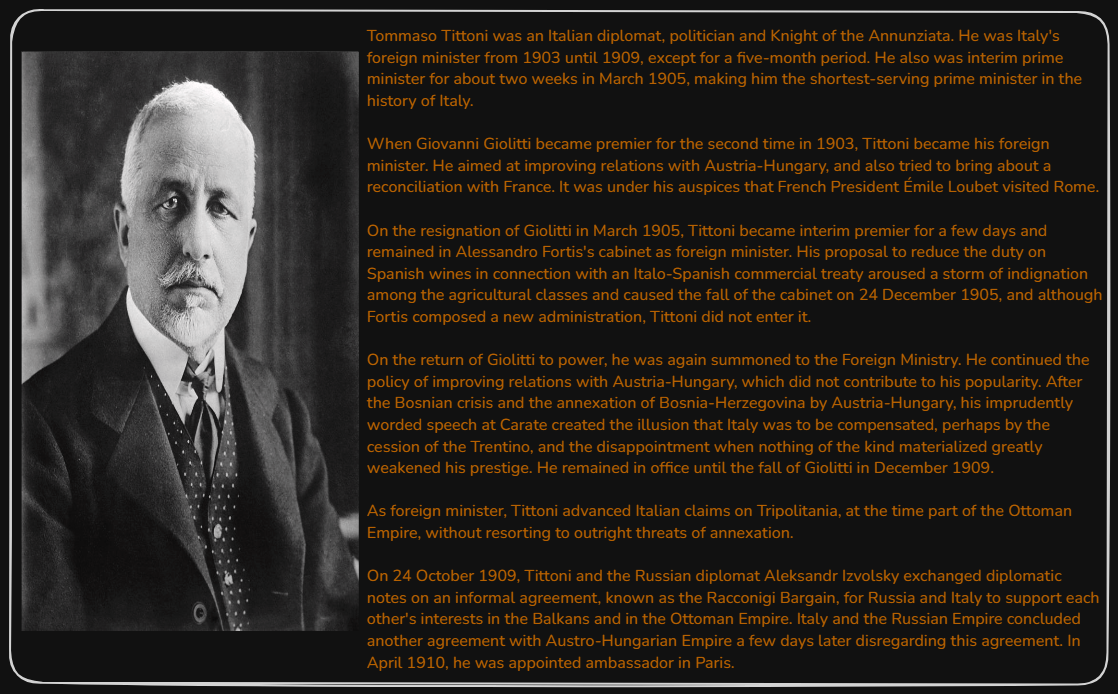
The Italian penetration of Libya received the strong backing of the Catholic-led Banco di Roma, whose vice president was Romolo Tittoni, the brother of Tommaso. The latter, at the time foreign minister, chose his brother’s bank to represent Italian interests in Libya. Expansion in Libya also attracted modern-minded industrialists like Giovanni Agnelli of FIAT and the Banca Commerciale. Thus, though Libya did not figure as an item on the government’s initial program, the question had been much discussed, and Giolitti might well have had the Italian claim in mind when he formed his government in the spring of 1911.⁴⁰ Certainly the landing of the German warship Panther at Agadir, Morocco, in March 1911 forced the Italians to examine their next moves. However, there were many ways to resolve the Libyan question, and it is not clear when Giolitti decided on war. As late as May 1911 he still considered the Ottoman Empire to be a cornerstone of European stability:
The integrity of what is left of the Ottoman Empire is one of the principles on which the equilibrium and peace of Europe is founded. . . . Is it perhaps in the interest of Italy to shatter one of the cornerstones of this old edifice? And what if we attack Turkey, [and] the Balkans move? And what if a Balkan war provokes a clash between two groups of powers and a European war?⁴¹
The Decision for War
Giolitti probably decided on war with Turkey in the late summer of 1911, but well before that, opponents like the Italian Nationalist Association and its newspaper, Idea nazionale, the Corriere della sera, and the pro-government newspapers La Stampa and La Tribuna mounted a strong campaign in favor of seizing the colony. On July 31, 1911, Alfredo Frassati commissioned journalist Giuseppe Bevione to write an open letter to Giolitti in La Stampa: “They say that you have no feel for foreign policy, that foreign for you means the South of Italy. Frassati/Bevione noted that Giolitti had been correct to stress domestic policy, but now ==either Italy succeeded Turkey in Libya or another power would do it, to the detriment of the Mediterranean balance of power.==⁴² An annoyed San Giuliano wrote to Giolitti on August 9 to complain about the language of the paper, which he called "a pro-government paper in everything but foreign policy." Even if the press campaign had no direct impact on the decision to go to war, ==the support of both La Stampa and the Corriere della Sera greatly reduced the risks of negative political fallout.==⁴³
Libya led Giolitti to terminate the parliamentary session in July 1911 without a resolution of the insurance monopoly. Both the prime minister and San Giuliano preferred to make the key decisions for war without parliament underfoot. They were not so much worried about pro-war sentiment driving policy as about giving opponents and supporters of the war any forum. San Giuliano explained:
The situation that can take shape in Morocco urgently demands from us a calm examination of the position to take and of the eventual resolutions to be prepared. This period of hectic and hurried parliamentary activity and the interrogations that might be presented in the Chamber lend themselves badly to this end and can even become harmful to our interests.⁴⁴
A letter from General Spingardi, the war minister, to Giolitti on August 19 gave an example of what San Giuliano had in mind. Spingardi informed Giolitti that Turati had complained that the troops on military maneuvers ran the risk of an outbreak of cholera and threatened to raise the matter in parliament. Giolitti, who had been suppressing information about the outbreak of cholera in Naples and elsewhere in 1911, feared the discussion of an outbreak of the disease in the army would raise the question of responsibility and fuel anti-military sentiment.⁴⁵
As pressure on Giolitti mounted, he nominated Camillo Garroni, the longtime prefect of Genoa, to be ambassador to Constantinople. The journalist Andrea Torre guessed that Garroni's appointment meant the occupation of Tripoli might not be far off.⁴⁶ In fact, Italy awaited only the settlement of German compensation for allowing full French control over Morocco. On July 28, San Giuliano set out the various options. The foreign minister stressed that, given the international situation, "Italy may be constrained to complete its military expedition to Tripolitania," but the government should still "seek to avoid it." War would be dangerous for the stability of the Ottoman Empire and might ignite a Balkan war or inflame anti-Austrian feelings in Italy. But San Giuliano argued that Italy needed to settle the matter before French commitments to support Italy's claim to Libya lapsed and before Italy was pressed for concessions by its allies in the Triple Alliance in exchange for their support. In reviewing the message, Giolitti highlighted San Giuliano's reservations in red, reflecting his own continuing caution and doubts about the larger context of the war.⁴⁷
Both Giolitti and his foreign minister were out of Rome during much of July, August, and September, as if to emphasize lack of activity on the part of the government. Giolitti even tried to delay the military call-up despite General Spingardi's protests that secret preparation for war was beginning to be impossible.⁴⁸ On September 14 Giolitti and San Giuliano agreed that for technical as well as diplomatic reasons, military action would be best in October or November. San Giuliano hoped to minimize repercussions in the Balkans by a war just at the beginning of the winter season and while the European powers were still distracted by the French seizure of Morocco. On September 22 he reported the good news that the Austrians and Germans, both unaware of Italian plans, would renew the Triple Alliance without modification.
War Minister Spingardi and chief of staff General Alberto Pollio were informed on September 18 that war would begin immediately; when Pollio asked for 20,000 men, Giolitti suggested that he double the estimate in order to get the job done rapidly. On September 17 Giolitti met with a less than enthusiastic Vittorio Emanuele to inform him of the decision. Giolitti's methods had both a political and a military price. Once started, the war bogged down, which might not have happened if the expeditionary force had been prepared farther in advance.⁴⁹
On hearing of the war, a joint meeting of the Socialist Party secretariat, the parliamentary deputies, and the General Confederation of Labor leadership discussed calling for a general strike against the war, but many moderate Socialists, especially from the South, where appeals for an Italian colony as an outlet for emigration resonated, openly supported the war. Bissolati and Bonomi made no objections to the war on principle. Turati and Treves were opposed to war, yet were skeptical that a general strike would be effective. Writing to the king, Giolitti dismissed the role of the Socialist Party: "I do not believe that the Socialist movement is important. Many Socialists are favorable to the venture, and this morning [Salvatore] Barzilai came to tell me that the Republicans do not approve of the conduct of the Socialists and will not create difficulties."⁵⁰
Giolitti was certainly correct in assuming that the country would accept the war. The old anticolonialist bloc of the turn of the century failed to materialize. At the Socialist congress in Modena, which opened just after the outbreak of the war, Turati revealed frustration and confusion over Giolitti's decision "because I do not know how to work it into the petty bourgeois geography of his governmental program." Yet he referred to the war as "a betrayal."⁵¹ Giolitti sought to avoid a complete rupture with the Socialist Party. In a major address on October 7, 1911, in Turin, he seemed almost to minimize the war by characterizing it as "a historic fatality" that could not be avoided but should not be overvalued. ==Giolitti now denied the connection that he had made in the 1880s between colonial expansion and reactionary domestic policy.==⁵²
Far from relegating the war to the category of ordinary administration, conservatives and Nationalists saw it as a way of reshaping the national debate to Giolitti's disadvantage. Sonnino's Giornale d'Italia accused the president of the Council of Ministers of pandering to Turati and to the Socialists. On October 8, Sonnino urged Andrea Torre to begin a new press campaign about the war.⁵³
General Spingardi was unable to stop Sonnino and Francesco Guicciardini from traveling to Libya on a military ship, but he did block any other politicians: "On my account, rightly or wrongly, I said no to all the others, and when word gets out about those two, imagine how many troubles on my shoulders." Frassati, now concerned about the new national mood, fought with journalist and budding Nationalist politician Giuseppe Bevione over the right to republish the "Open Letter to Giolitti" of July 1911 in Bevione's book on Libya.⁵⁴
Giolitti imposed rigorous censorship on reports coming out of Libya. Although the Socialist press was the main target, mainline papers were also hit. The Corriere della Sera's Luigi Barzini blamed Giolitti for the censorship: "The order to prohibit journalists from following the operations is from Giolitti. The order to prohibit the journalists from landing in Cyrenaica is from Giolitti." Reporters had to submit all their dispatches to the military authorities, and when correspondents from Avanti!, Il Lavoro, and Corriere della Sera were expelled from the colony, Claudio Treves protested directly to Giolitti.⁵⁵ Il Messaggero's reporting on an Italian landing in Tobruk drew a furious rebuke from Camillo Peano, Giolitti's undersecretary at Interior, who suggested that the paper be charged with divulging state secrets. Giolitti, who judged the publication unintentional, nevertheless agreed that "it is necessary to use all means to uncover who was the traitor."⁵⁶
Giolitti and San Giuliano controlled war policy. They made the decision to press for the annexation of Libya in November 1911, in order to put a fait accompli before both the Turks and the other European powers. When fighting persisted, Giolitti widened the area of conflict by occupying Rhodes and other Turkish islands in order to force a rapid peace.⁵⁷ The occupation of the islands was taken with full consciousness of the risks. San Giuliano wrote to Giolitti that Austria feared the Italian occupation of the Dodecanese islands would continue after the war. The foreign minister wondered if Italy should offer guarantees to Austria. Giolitti responded that Italy did not intend to keep the islands and that "such assurances must remain secret to facilitate the peace." Finally, Giolitti had a major voice in shaping the relatively moderate Treaty of Ouchy of October 18, 1912, which brought the war to an end.⁵⁸
Giolitti could never be called an economic imperialist, but he was not impervious to pressures for economic expansion in the Ottoman Empire, especially in the Balkans. Nonetheless, San Giuliano led the way in this area.⁵⁹ It was not entirely clear, however, that Italy was in a position to profit. San Giuliano made the case for an ambitious policy at the beginning of 1913: "As you well know, the political competition among the states that have significant interests in the East takes place today on the basis of industrial, commercial, and financial initiatives. In this area we have to struggle above all to sustain, as we must, our increased position in the East." But the Bank of Italy was much less enthusiastic about involving itself. Bonaldo Stringher was pessimistic after consulting with Milanese banking circles. Giolitti feared a slowing domestic economy and the shortage of investment capital within the country. Investments in the Ottoman Empire were important, but "in this moment it is not advisable to take capital out of the Italian market.¹⁶⁰ San Giuliano lamented to Camillo Garroni after the war ended that it was “impossible to obtain great support from Italian capital for initiatives in Turkey, given the opposition of the minister of the Treasury, that is, Tedesco, and, in the last analysis, of Giolitti.”¹⁶¹
The Consequences of Colonial War
Giolitti was aware of how exposed he was to the new Nationalist expectations. The Corriere della sera was quick to criticize any lack of commitment on the part of the government. Even La Stampa framed the war in terms that eerily foreshadowed the debates of 1918–1919: “I mean to say that if a fully victorious war does not bring with it an equally victorious peace, our present prestige will change ipso facto into the greatest discredit.”⁶² Once the Libyan war ended, ==Giolitti belatedly sought to return to his old policy of insulating Italy from the shocks of the international order and restoring the balance between foreign and domestic policy. ==But the Libyan adventure revealed Turkish weakness to the restive Balkan peoples, and the continuing instability strained relations between Austria and Italy.
The First Balkan War, which broke out in October 1912, just as the Treaty of Ouchy was concluded, pitted most of the Balkan states against Turkey. ==Giolitti set forth guidelines to keep Italy’s commitments limited: no action with Austria alone without a mandate from all the other European powers, especially from England; a strict interpretation of the casus foederis clauses of the Triple Alliance treaty in case of a conflict between Austria and Serbia; no commitments on future action to Austria; avoidance of any pressures to recognize the independence of Albania.⁶³ ==In January 1913 the London Conference, called to settle the First Balkan War, broke down over Turkey’s refusal to cede Adrianople, Crete, and the Aegean islands. A month later, fighting resumed in the Balkans. Serbia and Montenegro moved on the fortress of Scutari, which had been assigned to Albania. San Giuliano suggested that Italy join Austria in naval maneuvers off the Albanian coast to warn the Serbs and Montenegrins, but Giolitti was quite opposed: “This new attitude of Austria means that the militarist element has the upper hand and that the invitation to us works to limit our freedom of action and to tie us hand and foot in the service of [Austria].” Giolitti feared that Germany wanted to involve Italy in a general war, but he remained confident that Italy many still wanted peace; San Giuliano assured Giolitti that Italy could interpret the Triple Alliance in such a way to stay out of any war.⁶⁴
Giolitti struggled to keep newly aroused anti-Austria sentiments in Italy from passing over into diplomatic incidents. During the celebrations of the fiftieth anniversary of unification in 1911, Austria took offense at the official ceremonies at La Scala despite efforts by the prefect to censor all speeches. Giolitti ordered the prefect of Turin to ban any display of the flags of Trento and Trieste during the celebrations.⁶⁵ However, Austria did little to ease Giolitti’s burden. In July, San Giuliano, who was passing through Germany with the Italian royal family, was informed that Austria might attack Serbia over that country’s refusal to sign a peace treaty with Bulgaria to end the Second Balkan War. Austrian Foreign Minister Leopold Berchtold also contended that Italy might be obligated under the terms of the Triple Alliance. Without informing the king, San Giuliano telegraphed Giolitti on July 8 that “Austria has communicated to us and to Germany its intention to act when Serbia is victorious and defines such action as defensive, hoping to apply the casus foederis of the Triple Alliance that I believe quite inapplicable.” Giolitti fully supported San Giuliano’s interpretation on July 10: “If Austria intervenes against Serbia, it is evident that the casus foederis does not apply.”⁶⁶
In August, Konrad Hohenlohe-Schillingsfürst, the governor of Trieste, published a series of decrees dismissing Italian subjects from public employment in the city and making it more difficult for them to obtain Austrian citizenship. An outraged Giolitti protested to San Giuliano that “in Italy we are offended by the systematic persecution of everything Italian.” However, after reflection, Giolitti decided that it was better not to publish the Italian case, which was not strong under international law.⁶⁷
Libya and Domestic politics
In the hope of rapid victory, ==Giolitti kept the Chamber of Deputies from meeting in its fall session under Article 5 of the constitution, ==which freed the crown from informing the Chamber of declarations of war if it would complicate state security. This clearly anti-parliament measure worried liberals like Frassati and provoked lively protests from the Socialists, but it won the support of Sonnino and other opponents of Giolitti’s domestic policy who feared that patriotic fervor might allow Giolitti to sweep aside opposition to the life insurance monopoly.⁶⁸
Domestic pressures forced Giolitti into actions that deepened the fissure between himself and the Socialists. Rumors of a plot to kill Giolitti during his October 7 visit to Turin circulated. Then, on March 14, 1912, Antonio D’Alba managed to fire three shots at the king as he rode on the Via del Corso in Rome. D’Alba’s ties to the anarchists were unclear, but it brought back memories of the death of Umberto and possibly damaged Giolitti’s relationship with Vittorio Emanuele. Orders went out for increased surveillance of anarchist, Republican, and syndicalist subversives.⁶⁹ The revolutionary press was especially hard hit. Proceedings were opened against the Agitatore of Bologna and L’Internazionale and La gioventù socialista of Parma. The syndicalist Alceste De Ambris was imprisoned, as were young activists Benito Mussolini and Pietro Nenni. On March 15, 1912, La Soffitta published a list of judicial proceedings: 170 had been jailed, 60 were in exile, and 50 were still under investigation.⁷⁰ Anti-Giolittian and anti-parliament feelings grew stronger as the war dragged on. The Socialist Party was undergoing a process of massive change that swept away those with whom Giolitti had engaged in dialogue for the past fifteen years. By March 1912 the prime minister addressed a Socialist Party that no longer existed:
When the Socialists, representatives of the popular classes, found the government constituted as the representative of the privileged classes, naturally they held a greater ascendancy over the masses, permit me to say it, than they have today, now that the bourgeoisie has recognized its duties toward [the working classes]. The government . . . has taken in hand the cause of the popular classes and has adopted all those parts of the Socialist program that were practically acceptable.
Seeming not to notice Giacinto Menotti Serrati, Costantino Lazzari, and Benito Mussolini in the wings, he went on: “Socialism is no longer violent but reasonable, and I believe that one praises the party in noting this state of things.”⁷¹
What Giolitti lost on the Socialist side, he temporarily gained among the Catholics. It was almost as if the Catholics were waiting for the right moment to rally to the national cause and to leave behind divisive issues like the status of Rome. Catholic support for the war was so complete that it caused the Vatican to draw back. On December 1, 1912, a warning was issued to the newspapers of the “trust” headed by Count Giovanni Grosoli (Il Momento, Corriere d’Italia, Corriere di Sicilia, and L’Italia) that they were not in conformity with papal directives.⁷² But enthusiasm for Giolitti’s war did not necessarily translate into increased support for Giolitti personally. ==While the Vatican was quite comfortable within the Giolittian framework as long as restrictive suffrage continued, this did not mean that the Catholic political leadership would rally to Giolitti ==rather than the conservative Salandra and the Nationalists who appealed directly for Catholic support.⁷³
When parliament reconvened in February 1912, only two deputies of the constitutional majority, the Arabist Leone Caetani and Emilio Pinchia, voted against the annexation decree. Caetani, a Radical who represented a Roman college, became an inviting target for the Nationalist backlash.⁷⁴ The Radicals and clerical delegations voted in favor. The Republican and Socialist delegations split. Barzilai and thirteen other Republicans supported the war. Among the Socialists only Enrico Ferri voted in favor. He immediately resigned his seat and won reelection with government support. But for all practical purposes, two Socialist parties existed. Roughly half the Socialist deputies, led by Bissolati, Bonomi, and Cabrini, gradually withdrew from the party after they defied it by going to the Quirinale Palace to express their congratulations to the king on his escape from the assassination attempt in March 1912. The party formally broke apart at the congress of Reggio Emilia in July 1912, when the revolutionary current took over the party and moderates formed the Reformist Socialist Party. A similar process took place within the Republican Party when moderate pro-Libyan Republicans like Barzilai defied clear party policy by voting on February 23, 1912, in favor of the annexation decree. The refusal of the Socialist and Republican parliamentarians to respect decisions of the party congresses reinforced anti-parliament sentiments on the extreme left.⁷⁵
The suffrage and life insurance bills
The war smoothed the parliamentary road for the two major pieces of legislation left over from the 1911 session. In February 1912 a compromise insurance bill was presented. The industrialist Silvio Crespi noted that the original bill had been a Socialist measure and that “our Giolitti had become for the moment comrade Giolitti.” The private companies could continue operations for ten years under certain conditions: 40 percent of each policy would be ceded to the INA; a percentage of the profits of the companies would have to be invested in state bonds; and the Ministry of Agriculture, Industry, and Commerce must approve the rates to be charged for policies. With these changes the bill passed the Chamber of Deputies in July 1912. By early 1913 twenty-three companies had ceded their holdings to the state agency.⁷⁶
==The shift in the political winds was even more evident when the suffrage bill was debated in May. The conservative Pietro Chimienti stressed that “the necessary, indispensable assistance of the Socialist Party will not be needed for the triumph of the suffrage expansion,” ==but he then expressed lingering concerns. Conservatives would follow Sonnino in supporting the enlargement of the suffrage without fear of being swamped by the Socialist and clerical vote only if the liberals organized to meet the new challenges.⁷⁷
Proportional representation and the vote for illiterates and for women still presented problems. The continuation of single-member colleges, especially in rural constituencies, provided liberals some insurance that they might compete in the new order. Ever consistent, Sonnino preferred the immediate introduction of proportional representation but would vote for the existing bill without it. Not unexpectedly, the clerical Filippo Meda supported proportional representation, which would favor the well-organized Catholics. But when the Radical Caetani stated that he, too, was for it, Giolitti exploded: “If you ask me, I say that I do not want proportional representation, not now, not later. Therefore I am logical.” To his regret, he temporarily abandoned this position in 1919.⁷⁸
Giulio Alessio hoped that Giolitti understood the weakness of the liberals and would form a new party in alliance with the Radicals. However, ==Alessio cautioned against proportional representation in a country like Italy with a Socialist Party that would not cooperate with other democratic forces.⁷⁹ ==The gloomiest voice on the democratic left came from Turati, who seemed to be writing not only the epitaph of his leadership of the Socialist Party, but also that of Giolitti:
You can favor the industrial class today. . . . You can favor the proletariat. . . . But if you content everyone—the shopkeeper, the noble, the clergy, the agrarian, the right-wing Socialist, and you do not frighten anyone, you fool yourself that you are progressing. . . . To what end does your incontestable power serve? I deplore that you waste it. I deplore that you have this supreme ability to present a beautiful, a great reform in order to diminish it, to obscure it, to make it innocuous and manageable.⁸⁰
Giolitti stressed the conservative features in his legislation, especially the provision to keep illiterates from voting before age thirty and the denial of the vote even to educated women on grounds that it would be a double vote for the wealthy. He admitted that the liberals were not as well organized as the clericals and Socialists, yet offered no real prescription for overcoming this problem.⁸¹ But there was no denying that the Libyan war and the new electoral law had turned a page in the history of liberal Italy. For over a year patriotic and nationalist sentiments had been aroused on the right and center. The Italian Nationalist Association claimed the legacy of victory and Giolitti, who never waved the flag, found it hard to compete. On the left, Giolitti’s dialogue with the reformists stalled.⁸²
Giuseppe Prezzolini touched on a weakness that would plague Giolitti after the Libyan war. In an article for La Voce, “La fine del nazionalismo,” Prezzolini commented:
It is a bourgeois peace, a modern peace, in shirtsleeves, without the illusion of any idealism and sentimentalism. . . . But what strikes one about this peace is its character, shall we say, bourgeois, or rather Giolittian. At base, this man, cold and bureaucratic, industrious and practical, is what is needed for a people that too often allows itself to be led by passions and rhetoric. Giolitti is a sign of the times; he is the sovereign appearance of “prose” in Italian politics.
Prezzolini observed that Giolitti had “many admirers but not a single person would die for him. He is esteemed as a politician, but from afar.”⁸³
The final year of Giolitti’s government was filled with mixed messages. The Italian Socialist Party was now in the grip of its revolutionary, antimilitary wing. Giolitti ordered greater cooperation between Public Security forces and the military in garrison towns in order to stop propaganda by the Socialist Youth Federation in the barracks.⁸⁴ But he never entirely cut off a dialogue with the reformist Socialists and the unions. For instance, Giolitti protected the reformist-led peasant leagues and cooperatives around Molinella, near Bologna. By the summer of 1912 Giolitti’s prefect, Ernesto Dallari, was accused by local landlords of tolerating activities of the peasant leagues so as not “to compromise a political program that for many years has been characterized by concessions and surrenders.” The situation deteriorated to the point that Dallari (who would be removed by Salandra and replaced by Domenico Quaranta in 1914) informed Giolitti that his relations with the agrarian leaders had practically broken down.⁸⁵ Giolitti also worked with Turati on a law to set up municipal pharmacies despite considerable opposition from conservatives. The measure reflected Giolitti’s continuing distaste for certain aspects of free-market competition: “The business of pharmacies is not commerce like all the others: the pharmacist, among other things, has and must have the obligation to put at the disposition of the public all the remedies that are judged by medical science to be useful to health. . . . ==Human life is worth something more than the saving of two or three centesimi through competition.”⁸⁶
In May 1913 Giolitti engaged in one of his most visible conflicts with management over the handling of a labor dispute. The Turinese branch of the Metalworkers Federation struck the auto industry. The strike became a general lockout in the entire metal industry when Luigi Bonnefon Craponne, the French-born head of the Industrial League, urged his membership to shut down. Reflecting the position of the Giolitti government, La Stampa called the lockout “a very serious error” and asked how a reactionary like Craponne could remain head of the Industrial League. La Stampa also criticized the extension of the lockout to industries not on strike. Giolitti instructed the prefect of Turin to inform Craponne and the Turin Industrial League that they might have to provide for their own protection if they continued the lockout. A semiofficial notice published in La Tribuna made the government’s position painfully clear: “Moreover, without engaging in out-of-place chauvinism, we must deplore that the prime mover and counselor of this tactic is a foreigner.” Faced with a clear and highly public threat from the government, Craponne resigned.⁸⁷
1913 Election
Almost everything in 1913 was done with an eye to elections, widely predicted for the fall. The new electoral law challenged all the parties. In 1909 just under 3 million voters, 8.2 percent of the population, qualified; in 1913, well over 8 million, 24.2 percent of the population, could vote. Theoretically, the new law had the greatest potential of altering the Southern political landscape. Now one-quarter of the population in regions like Basilicata and Calabria had the vote.⁸⁸ However, the single-member constituency system, with its small town and rural bias, still provided a cushion for the liberals as they faced the great leap in the dark. When Treves proposed proportional representation based on large electoral districts, Giolitti warned that it “would be a suicide for you and your friends.” Treves rejoined that he was ready for the sacrifice because the logic of universal suffrage called for it. With the clerical vote in mind, Giolitti reminded the Socialist: “In Italy there are organizations much larger than yours.”⁸⁹
Giolitti intended to steer the liberals on a difficult course in alliance with both the clericals and the anticlerical Radicals who were in his government. The Radicals were determined to take advantage of their new prominence to run a full slate of candidates, which meant that they inevitably would contest the seats of many Giolittian liberals who were their alliance partners in the majority. The conflict gave new ammunition to anti-Giolittian Radicals like Romolo Murri and Antonio De Viti De Marco, who wanted to take their party out of the government.⁹⁰
Nationally the key to survival for many liberals was the alliance with the Catholics, who imposed a set of conditions that became known as the Gentiloni Pact. Eventually, over 200 liberal candidates had the non expedit removed when they accepted the terms set by Count Vincenzo Gentiloni, the head of the Catholic Electoral Union. Among the provisions were some that directly involved church-state issues: opposition to any law aimed at religious congregations (as happened in France); defense of private (Catholic) schools; support for parents who wanted religious instruction in public schools; and absolute opposition to divorce.None posed particular problems for Giolitti, who had long sought compromises favorable to the church.⁹¹
As usual, the Socialists were the target of the government’s electoral mobilization in Piedmont’s major centers like Alessandria, Novara, and Turin, but the Piedmontese liberals resisted better than their compatriots elsewhere in the North.⁹² In Turin, where the electorate more than doubled, Edoardo Daneo (Turin I), Luigi Grassi (Turin II), Giuseppe Depanis (Turin III), Felice Panié (Turin IV), and Cesare Ferrero di Cambiano (Turin V) received Catholic support, but the Turinese liberals still lost ground. Daneo held his seat. The veteran Socialist Oddino Morgari kept Turin’s 2nd college. Another Socialist, Pilade Gay, ousted Panié. (When Gay died in early 1914, his seat was won by the Nationalist journalist Giuseppe Bevione.)⁹³ In much of the Po Valley the liberals needed clerical support against the Socialists, and even then, many did not survive. In Emilia these alliances were accompanied by growing anti-Giolittian sentiment, especially in Bologna, where militantly conservative leaders of the Bolognese Agrarian Association had opposed both the life insurance monopoly and the new suffrage bill.⁹⁴ In Parma only one of three liberal seats survived. In the province of Reggio Emilia, the longtime deputy and undersecretary in the government, Vittorio Cottafava, eked out a victory in a runoff election by beating back a strong Socialist challenge with the help of the Catholics. In the rest of the province the Socialists dominated. In Tuscany and Umbria the process of dismantling liberal power was slowed by the alliance with the clericals, but only one of the Florentine colleges was in liberal hands after the elections.⁹⁵
The alliance with the clericals created a deep crisis of conscience for many traditional liberals. Luigi Albertini feared that in a chloroformed country with characterless elections, “the clericals make gains and when we will want to fight them, it will be too late.” He wondered how Giolitti could legislate to please the Estrema and run elections to pay off the clericals.⁹⁶
Rome provided an interesting battleground. The 1st college represented a clear example of liberal solidarity. There Sonnino, the Freemasonic Radical ex-mayor of Rome Ernesto Nathan, and Giolitti joined behind Prince Scipione Borghese to defeat Antonino Campanozzi, the leader of the postal union.⁹⁷ Unexpectedly, a third candidate, Domenico Oliva, a Nationalist and collaborator on Sonnino’s Giornale d’Italia, entered the race with Catholic support. To avoid splitting the liberal vote, Sonnino informed Oliva that he would not receive the backing of the Giornale d’Italia. The threat backfired when Oliva withdrew in favor of the more dynamic and ambitious Nationalist Luigi Federzoni, who was elected with clerical support despite the continued opposition of Sonnino. In Rome’s 4th college Radical Leone Caetani, one of the rare opponents of the Libyan war, ran against the Nationalist Luigi Medici del Vascello, who also received Catholic backing. With no possibility of a Socialist victory, both the government and Sonnino supported Medici.⁹⁸
Giolitti worked hard to defeat vocal opponents of the Libyan war. Bissolati and the Republican Eugenio Chiesa faced little opposition, but Gaetano Salvemini, a prominent opponent of the war, met strong resistance at Bitonto.⁹⁹ As usual, in the Southern colleges Giolitti worked in alliance with the patronage systems of prominent families. Private armed gangs made campaigning difficult for candidates who did not receive sufficient protection from the prefecture. When the government decided to back the conservative follower of Sonnino, Alfredo Codacci-Pisanelli, the Radical opponent learned what it was like to have the full weight of the prefecture against his candidacy.¹⁰⁰ Giolitti even went so far as to back the Socialist Stanislao Senape against Antonio De Viti De Marco, a longtime opponent. To confuse matters further, both the Socialist and De Viti De Marco received some clerical backing, but Senape even employed a cross in his campaign. However, this race was an anomaly. Throughout Puglia the Gentiloni principles were generally accepted by the liberals who received undivided Catholic backing.¹⁰¹ Monsignor Nicola Giannattasio of Nardo wrote to the bishop of Lecce that “the Gentiloni program seems to me to have been worked out with Giolitti. I believe that we can be content.” The result was that in the Salento, the non expedit was removed in almost all the colleges.¹⁰²
A good example of how the pact functioned came from the province of Lecce, where the Giolittian Giuseppe Pellegrino was running for reelection. In 1909 he had received Catholic support but had not given any commitments. Although Pellegrino argued after the election that he had made no promises, a letter of October 3 from the bishop of Venosa to the bishop of Lecce presented a very different picture: “Signor Massa has brought verbally the most ample assurances from Pellegrino (who it seems has understood his precarious position).” After Pellegrino gave oral assurances about the Gentiloni principles, the non expedit was lifted.¹⁰³
Postelection fallout
The 1913 elections weakened, but certainly did not dismantle, the Giolittian system of power. The liberal bloc dropped from 370 to 307, but most were still Giolittians. The Sonnino-Salandra group had twenty-one seats. Six Nationalists were elected. The clericals jumped from nineteen to twenty-eight, but the most striking gains were made by the left: ==the Socialists went from twenty-six to fifty-two; the Radicals from fifty-one to seventy-three; Bissolati’s new Reformist Socialist Party, from fifteen to twenty. But the gains of the now divided Estrema did not provide enough momentum to displace the liberal bloc.¹⁰⁴ ==In the South, where universal suffrage might have caused a political earthquake, only modest changes resulted. In 1909 fifty new deputies (thirty-three elected for the first time) entered parliament. The 1913 delegation had only sixty-two new members, of whom forty-three were elected for the first time. The percentage of voters actually declined from 1909.¹⁰⁵
Giolitti kept his majority, but although he was still able to control many of the elected deputies, the electoral mechanisms in large parts of Italy eluded his grasp. This loss of control was particularly clear in the case of the Catholic electorate. A scandal erupted when Count Gentiloni gave an interview to the Giornale d’Italia in which he boasted that 228 deputies were elected with Catholic support.¹⁰⁶ Though the clerical alliance was known before the elections, its scope was not, and Gentiloni’s interview only increased the problems for the government. The left-leaning Il Messaggero published the list of 228 names. Salandra found the whole episode distasteful and urged Alberto Bergamini not to republish the list because it “has the air of a public and personal denunciation of the largest and best part of those who were and will be our friends.”¹⁰⁷ During the parliamentary debate, Giolitti made a curiously provocative remark about those who signed the Gentiloni principles: “Don’t call those who signed liberals!” When the Radical Luigi Fera said that he did not know if agreements had been made with the Catholics, Giolitti interjected with an obviously false statement: “There was never any form of an accord, neither now nor in the past.”¹⁰⁸ The exchange between Giolitti and Fera surprised the clerical Agostino Cameroni, who pointed out the well-known support given to governmental candidates. Giolitti snapped back that the Catholics were often on the other side. When Cameroni responded, “It does not take from the Catholics the credit for having supported many [governmental candidates] even if they fought a few,” Giolitti refused to give ground: “They fought more than they supported.”¹⁰⁹
Sonnino criticized Giolitti for his failure to create a large progressive conservative party that could avoid falling into dependence on the clericals. In contrast, Antonio Salandra positioned himself as a staunch defender of church, property, and free enterprise.¹¹⁰ The most bitter dissent over Giolitti’s alliance strategy came from the Socialists. Bissolati appealed to the Radicals to break with the government and join him in a new independent bloc on the left. A disillusioned Turati saw his strategy in ruins: “I have been sitting in this Chamber for more than fifteen years, several of my friends have been here even longer. Well, I confess that we have never known with absolute certainty if, when the Honorable Giolitti concedes something to us that we really wanted, he does it to support us or to play us for fools.”¹¹¹ And it fell to the ex-syndicalist and future minister under Giolitti, Arturo Labriola, to write the obituary for the Giolittian system. The days when Giolitti was hailed as “comrade Giolitti” were but a memory: “Times have changed. The Nationalists call themselves conservatives. In reality, they are revolutionaries. On one side, there is the Nationalist revolutionary Italy; on the other, a Socialist Italy, but there is no longer a Giolittian Italy.” Labriola continued: "Your system did not create an eternal regime, Honorable President of the Council. Even this regime was mortal and contained within it the germ of its dissolution. The moment came when we saw that the Giolittian regime was undermined from all directions and those underminers were neither his followers nor adversaries in this hall. This hall counts little in the destiny of the nation. The Giolittian regime is a regime of social accord and peace. . . . But now who does not see that things have changed? . . . The lucky star is extinguished, the constellation has changed, things have been turned upside down.”¹¹²
At the end of the debate an imperturbable Giolitti offered a final defense of measured social reform: “I believe that history reveals that all serious and lasting human progress comes step by step.” When challenged again on the Gentiloni Pact, Giolitti repeated his earlier, quite absurd, statement, almost defying the opposition to bring him down: “I have already declared in response to an interruption that for me those who signed, obliging themselves to a fixed policy, cannot be considered liberals.”¹¹³
With only the Socialists, Republicans, Reformists, and an occasional independent voting against, the government won a vote of confidence by an overwhelming 362–81. Even Giolitti’s liberal opponents like Sonnino announced that they would vote for the government. Nor did Albertini want Giolitti to leave power until Salandra’s succession could be clarified.¹¹⁴ The observant Anna Kuliscioff noted that Giolitti deliberately tried to provoke the signers of the Gentiloni Pact to topple his government. Salandra was, she felt, the leader of the opposition.¹¹⁵
By the beginning of 1914, Giolitti faced some very difficult choices. La Stampa noted that the rising cost of living squeezed wages, and that made it harder to shift labor costs to industry.A consumptionist policy that united industrialists, middle-class liberals, and trade unions along the model of the English Liberal Party meant reducing the cost of food and alienating the agrarian wing of the Giolittian majority.¹¹⁶ Neither labor nor industry was in a cooperative mood. Industrialists like Mario and Pio Perrone of the Ansaldo trust moved entirely out of the Giolittian orbit to finance the far-right Italian Nationalist Association with the help of FIAT vice president Dante Ferraris. Ansaldo also set up its own system of financing in the Banca Italiana di Sconto, and the Perrones used newspapers under their influence, like the Nationalist Idea nazionale, to launch a running attack on the “foreign” and increasingly Giolittian Banca Commerciale.¹¹⁷
Finally, Giolitti had kept hidden from the press and from parliament the amounts needed for the Libyan war. Treasury Minister Tedesco wrote to Giolitti in January 1914 that every cabinet minister was pressuring for more: “At the Foreign Ministry they believe that great power politics are carried out with great means, and they do not understand that Italy is not France, nor England, nor Germany.” At Public Instruction, he complained, they invented new needs on a daily basis, and “it is not even worth speaking about Public Works.” All of this came at the moment when opposition critics like Salandra were calling for increased military expenditures.¹¹⁸
The fall of the Giolitti Ministry
Giolitti left Rome for Cavour at the end of the parliamentary session with a bad cold and a need for rest. At the end of January the Radical Party congress voted in favor of a motion to pass into the opposition.¹¹⁹ The defection of their party made the position of Radical ministers Ettore Sacchi and Luigi Credaro impossible. Their resignation brought down the government on March 10, 1914. Rather than reorganize his ministry, Giolitti withdrew, even though, as the Corriere della sera pointed out, he still held a majority in parliament and had not been defeated on a confidence vote. In fact, the Tribuna reported that the vote in the Radical parliamentary group to leave the government was fifteen in favor, fourteen abstentions, and one negative vote, a decision that a determined Giolitti might easily have reversed.¹²⁰
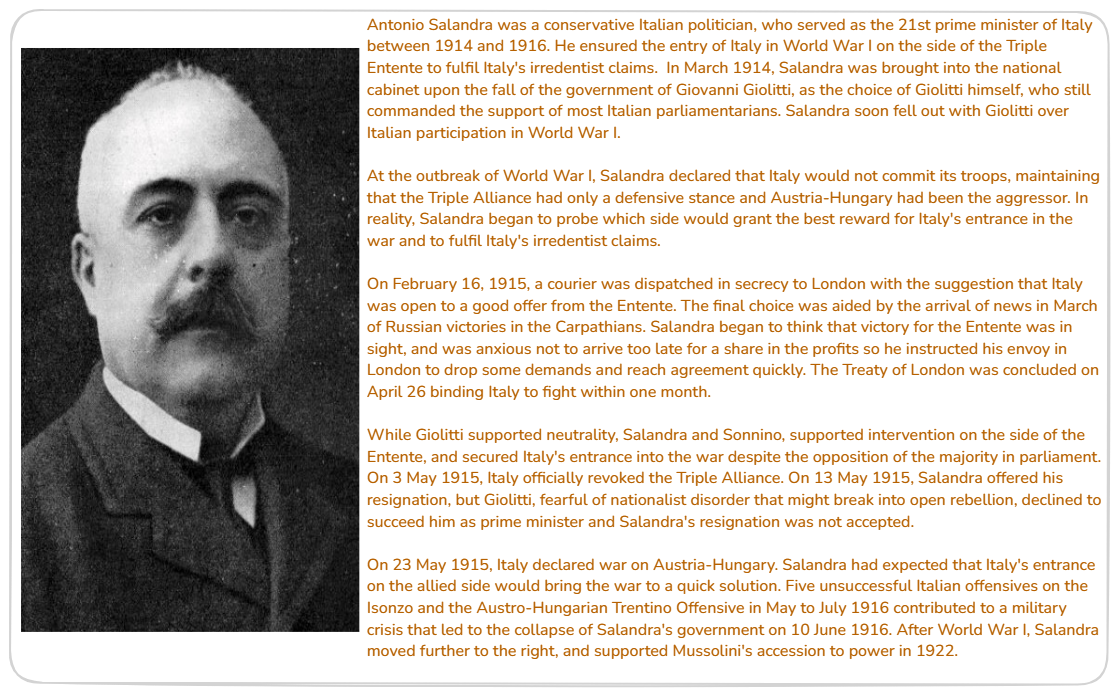
Giolitti’s opponents on both right and left were wary about leading a government that could survive only with Giolitti’s blessing. Sonnino no longer wanted to fill in between Giolitti’s terms in office without explicit guarantees from the Giolittian majority and from the extreme left. Antonio Salandra emerged as acceptable both to the opposition and to Giolitti, who understood that although Salandra had great ambitions to remake the majority, he operated exclusively within the orbit of parliament, where Giolitti was the undisputed master. Salandra took power in 1914 on terms not very dissimilar to those offered to Sonnino and Luzzatti. His government would survive as long as the Giolittians remained patient.
If the choice of Salandra was not surprising, Giolitti’s refusal over the next year to take back the reins of government and his trust in Salandra remain inexplicable. Nitti recalled that he protested to Giolitti that Salandra was not just a political opponent but a declared enemy. He wondered if Giolitti might have been fooled by Salandra’s “certain Levantine indolence”; “he remained, when he could, for long hours reading and resting in his armchair.” Nitti recalled Giustino Fortunato’s remark that Salandra would pardon everything except someone who made him do a day’s work. Despite these defects, Salandra’s long record of opposition brought him support on the anti-Giolitti right and left. The problem facing the new prime minister in April 1914 was to make something of this diffused and largely negative support. To everyone’s surprise, he did.¹²¹
Summary
The New Anti-Giolittianism (1908–1910)
- Growing discontent with giolittismo from multiple directions: democratic left (especially Southern ties), young intellectuals (La Voce circle led by Giuseppe Prezzolini), and right-wing Nationalists.
- Italian Nationalist Association (founded 1910) promoted imperialism/war as antidemocratic tools to overthrow Giolitti.
- Key critics: Gaetano Salvemini (radical reform), Ettore Ciccotti, Romolo Murri.
Sonnino to Luzzatti (1910–Early 1911)
- March 1910: Sonnino forms government but lacks skills to control Chamber; fails on maritime conventions.
- March 1911: Luzzatti government formed with Giolitti’s backing; fragile right-left coalition.
- Luzzatti pushes cautious electoral reform (expanded suffrage but conservative safeguards like mandatory voting).
Electoral Reform & Luzzatti’s Fall (1911)
- February–March 1911: Luzzatti’s ministry collapses under pressure from rail strikes, cholera measures, and internal divisions.
- March 18, 1911: Giolitti calls for broader suffrage expansion (to ~8.4 million voters), leapfrogging Luzzatti.
Offer to Bissolati & Nitti Appointment (1911)
- Giolitti offers Bissolati government post + reforms (life insurance nationalization, expanded suffrage).
- Reformists split; Bissolati/Bonomi group leans toward participation but ultimately declines.
- 1911: Francesco Saverio Nitti joins government; marks peak (and future rivalry) in Giolitti-Nitti relationship.
Life Insurance Monopoly (1911–1913)
- Nationalization of life insurance to fund pensions/social insurance.
- Fierce opposition from Banca Commerciale, insurers, free-traders.
- Compromises reached; law passes with modifications.
The Libyan War & Its Consequences (1911–1913)
- September 1911: Giolitti decides on war against Ottoman Empire for Libya.
- Shifted focus to foreign affairs; boosted Nationalists; created precedents for bypassing Parliament.
- War accelerated revolutionary left rise in Socialist Party; ended reformist dialogue.
- October 1912: Treaty of Ouchy ends war; First Balkan War follows.
1913 Elections & Post-Election Fallout
- Universal male suffrage dramatically expands electorate (~24.2% of population).
- Gentiloni Pact: Catholics support liberals in exchange for concessions; ~200 liberals benefit.
- Liberals lose seats but retain majority (~307); gains for left (Socialists, Radicals) and Nationalists.
- Clerical alliances strain traditional liberals; deepens Giolitti’s reliance on patronage.
Overall Theme: Giolitti’s system reached its peak and began unraveling. Libyan War and suffrage expansion transformed politics, empowering new forces (Nationalists, reformist/revolutionary Socialists) while eroding the old Giolittian consensus. Giolitti maintained control through pragmatism and alliances but faced mounting opposition from all sides by 1914.
September 1911: The Decision for War
Political Context
By 1911 Giolitti departed from his long-standing focus on domestic reform by deciding to invade Ottoman Libya. Although colonial expansion had been discussed for years, he remained cautious until late summer 1911 because he feared wider European instability. :contentReference[oaicite:0]
Key Figures
- Giovanni Giolitti – Prime Minister
- Antonino di San Giuliano – Foreign Minister
- General Paolo Spingardi – War Minister
- General Alberto Pollio – Chief of Staff
- King Vittorio Emanuele III
- Alfredo Frassati (La Stampa)
- Giuseppe Bevione
- Filippo Turati, Leonida Bissolati, Ivanoe Bonomi
Reasons for War
Strategic Reasons
- Prevent another European power from occupying Libya.
- Preserve Italy's position in the Mediterranean.
- Exploit Ottoman weakness before diplomatic circumstances changed.
- Act before France withdrew support for Italy's Libyan ambitions.
- Avoid being forced into concessions by Triple Alliance partners. :contentReference[oaicite:1]
Diplomatic Considerations
San Giuliano repeatedly warned that war should still be avoided if possible because it could:
- destabilise the Ottoman Empire,
- provoke a Balkan conflict,
- increase anti-Austrian sentiment in Italy.
Military action was delayed until autumn 1911 to minimise international repercussions while Europe remained distracted by the Moroccan Crisis. :contentReference[oaicite:2]
Government Decision-Making
Policy
Giolitti deliberately avoided parliamentary involvement by:
- ending the parliamentary session,
- delaying mobilisation where possible,
- making preparations secretly with San Giuliano.
Reasoning
The government believed parliamentary debate would:
- expose military preparations,
- encourage political opposition,
- complicate diplomacy,
- risk anti-military criticism (especially after cholera outbreaks). :contentReference[oaicite:3]
Benefits
- Preserved secrecy.
- Allowed rapid executive decision-making.
- Reduced organised parliamentary opposition.
Disadvantages
- Weakened parliamentary government.
- Established precedents for executive rule during wartime.
- Increased criticism from Liberals and Socialists.
September–October 1911: Beginning the War
Military Preparations
Decisions
- War postponed until October.
- Pollio's troop request doubled.
- Expedition launched before complete military preparation.
Benefits
- Achieved strategic surprise.
- Took advantage of favourable diplomatic timing.
Disadvantages
- Poor preparation caused the campaign to become prolonged.
- Military operations quickly bogged down. :contentReference[oaicite:4]
Socialist Response
Divisions Within the Left
Supported the War
- Leonida Bissolati
- Ivanoe Bonomi
- Many moderate Southern Socialists
Opposed the War
- Filippo Turati
- Claudio Treves
However:
- opponents doubted that a general strike would succeed.
- the traditional anti-colonial coalition largely collapsed. :contentReference[oaicite:5]
Giolitti's Assessment
Giolitti concluded:
- Socialist resistance was weak.
- Republicans would not obstruct the government.
- Public opinion largely accepted the war.
Benefits
- Limited domestic resistance.
- Reduced risk of revolutionary action.
Disadvantages
- Permanent split between Giolitti and much of the Socialist movement.
- Strengthened revolutionary Socialists over reformists.
October 1911: Managing Domestic Politics
Public Position
Giolitti attempted to minimise the significance of the conflict.
He described it as:
- "a historic fatality,"
- unavoidable,
- not central to domestic politics.
He also abandoned his earlier belief that colonialism automatically produced domestic reaction. :contentReference[oaicite:6]
Reasoning
He hoped to:
- preserve dialogue with reformist Socialists,
- prevent politics becoming dominated by imperialism.
Benefits
- Maintained some moderate Socialist contacts.
- Prevented complete political polarisation.
Disadvantages
- Nationalists accused him of lacking patriotism.
- Conservatives used the war against him politically.
Wartime Censorship (1911)
Policy
Giolitti introduced extensive censorship.
Measures included:
- censorship of Libyan reporting,
- military approval of journalists' dispatches,
- expulsion of reporters,
- investigations into leaks.
Key Figures
- Luigi Barzini
- Claudio Treves
- Camillo Peano
Reasoning
Government argued censorship protected:
- military security,
- operational secrecy,
- national unity.
Benefits
- Reduced disclosure of military information.
- Protected military operations.
Disadvantages
- Press freedom severely restricted.
- Increased criticism from newspapers.
- Damaged Liberal constitutional traditions. :contentReference[oaicite:7]
November 1911–October 1912: Escalation and Peace
Annexation of Libya
Policy
Giolitti and San Giuliano formally annexed Libya in November 1911.
Reasoning
To create a diplomatic fait accompli before:
- Turkey,
- France,
- Austria,
- other European powers.
When fighting continued they occupied:
- Rhodes,
- the Dodecanese Islands.
Austrian Concerns
Austria feared Italy would permanently retain the islands.
Giolitti privately assured Austria that:
- occupation was temporary,
- assurances should remain confidential to facilitate peace.
Treaty of Ouchy
Date
18 October 1912
Outcome
- Ended the Italo-Turkish War.
- Produced a comparatively moderate peace settlement.
- Confirmed Italian control over Libya. :contentReference[oaicite:8]
Benefits
- Colonial acquisition achieved.
- War formally concluded.
Disadvantages
- Balkan instability increased.
- Relations with Austria became more strained.
Economic Dimensions
Supporters of Expansion
Expansion received backing from:
- Banco di Roma
- FIAT (Giovanni Agnelli)
- Banca Commerciale
- Colonial pressure groups
Opposition
The Bank of Italy remained cautious.
Key Figure
- Bonaldo Stringher
Reasoning
Concerns included:
- slowing domestic economy,
- shortage of investment capital,
- excessive overseas commitments.
Benefits
- Potential commercial expansion.
- Increased Italian influence in the Mediterranean.
Disadvantages
- High financial costs.
- Diverted investment from Italy.
- Increased economic risk.
Libya and Domestic Politics (1911–1912)
Constitutional Changes
Giolitti prevented Parliament meeting during the early stages of the war using Article 5 of the Constitution.
Reasoning
- Maintain secrecy.
- Avoid parliamentary interference.
- Protect military operations.
Benefits
- Greater executive flexibility.
- Faster wartime decision-making.
Disadvantages
- Viewed as anti-parliamentary.
- Alarmed Liberals.
- Increased Socialist hostility. :contentReference[oaicite:10]
Repression
Government expanded:
- surveillance,
- censorship,
- prosecutions,
- arrests of revolutionary activists.
Notable figures arrested included:
- Benito Mussolini
- Pietro Nenni
- Alceste De Ambris
Benefits
- Reduced revolutionary agitation.
- Strengthened state authority.
Disadvantages
- Radicalised the Socialist movement.
- Destroyed cooperation with reformist Socialists.
- Increased anti-parliamentary feeling. :contentReference[oaicite:11]
The Balkan Crisis (1912–1913)
First Balkan War
Following the Treaty of Ouchy:
Giolitti instructed that Italy should:
- avoid acting with Austria alone,
- interpret the Triple Alliance narrowly,
- avoid unnecessary commitments,
- avoid recognising Albanian independence prematurely. :contentReference[oaicite:12]
Relations with Austria
Key Figures
- Giolitti
- San Giuliano
- Leopold Berchtold
Giolitti rejected Austrian pressure to support military intervention against Serbia.
Reasoning
He feared:
- Austria wanted to restrict Italian independence.
- Germany hoped to involve Italy in a wider European war.
He insisted the casus foederis did not apply if Austria attacked Serbia first. :contentReference[oaicite:13]
Benefits
- Preserved Italian diplomatic flexibility.
- Reduced likelihood of immediate European war.
- Maintained Italy's independence within the Triple Alliance.
Disadvantages
- Increased tensions with Austria.
- Nationalist criticism intensified.
Historical Significance
Major Achievements
- Secured Libya as an Italian colony.
- Maintained relative diplomatic restraint despite expansion.
- Avoided immediate involvement in wider Balkan conflicts.
- Preserved freedom of action within the Triple Alliance.
Major Weaknesses
- Shifted politics away from domestic reform towards imperialism.
- Undermined parliamentary constitutional practices.
- Expanded censorship and executive authority.
- Destroyed Giolitti's long-standing relationship with reformist Socialists.
- Strengthened Nationalism and revolutionary Socialism simultaneously.
- Increased tensions with Austria, contributing to the unstable international environment before the First World War.
Overall Assessment
The Libyan War marked a decisive turning point in Giolitti's career. Although he achieved Italy's colonial objective while attempting to contain wider diplomatic consequences, the war fundamentally weakened the political system he had built. Executive government, censorship, nationalist politics, and the collapse of cooperation with reformist Socialists all accelerated, leaving Liberal Italy more polarised and less capable of managing the crises that followed in 1914.